
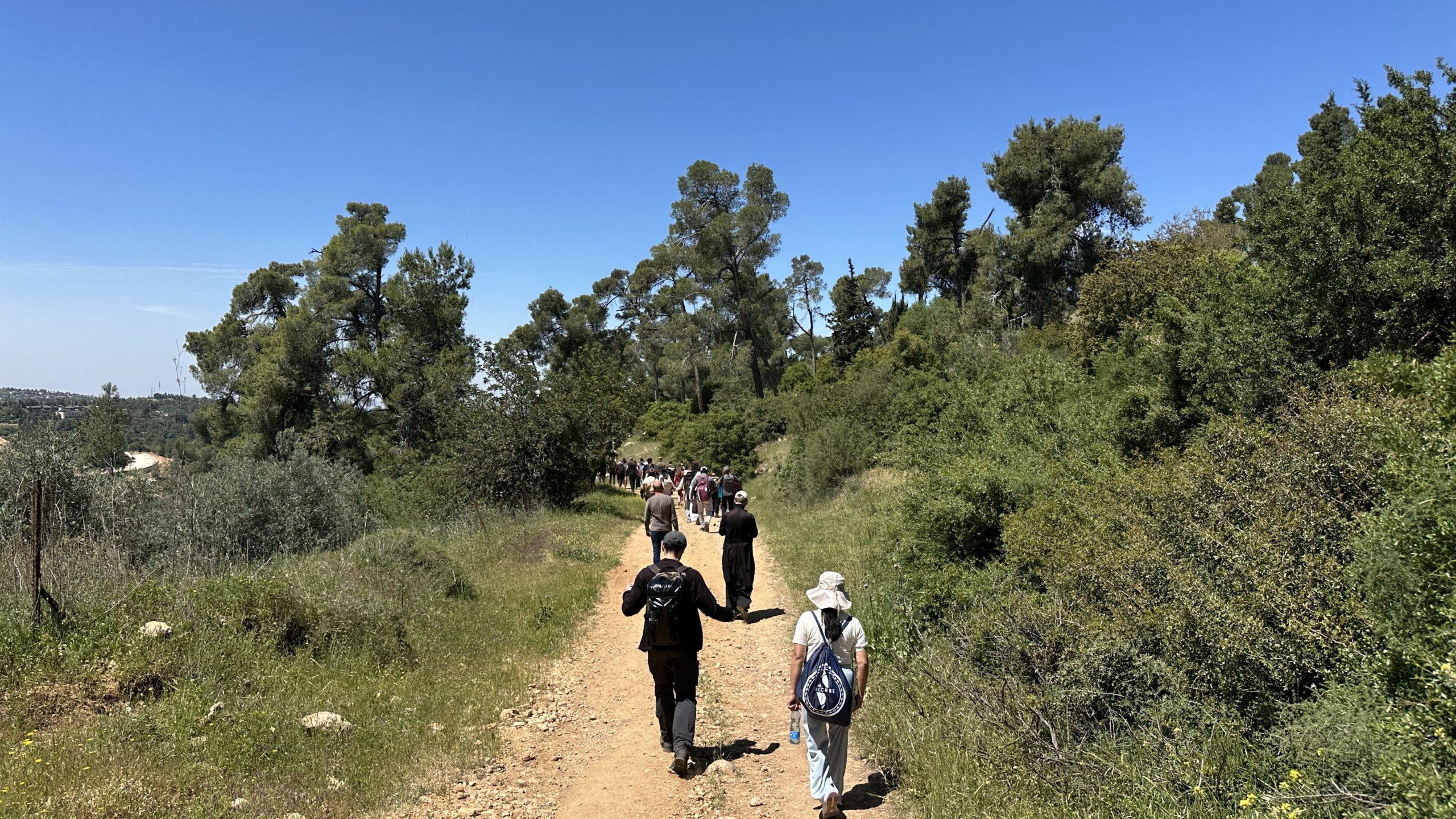
On the road to Emmaus between Saxum and Neve Ilan
I gave this meditation during the service at the Presbyterian Church in Lahore on 23 November 2025. I drew a parallel between the story of the pilgrims of Emmaus and the JC2033 initiative.
Since the beginning of the JC2033 vision, the Holy Land has occupied an important place, because it all began in Jerusalem almost 2000 years ago. But the complex situation and conflicting narratives led us to pray about how to remain connected to Jerusalem. This is how the idea of an annual walk on the road to Emmaus, until 2033, emerged, in preparation for the 2000th anniversary of the resurrection.
Emmaus is an uncertain geographical location, but above all a spiritual journey: not knowing its exact location means that it can be anywhere. Since the resurrection, all our paths can become paths to Emmaus where the Risen One joins us. Through his cross, he has reconciled humanity with God: ‘he is our peace’ (Eph 2:14). The journey towards 2033 is as important as the celebration itself.
We have already made several walks from Jerusalem, during which we visit Christian and Jewish communities and meditate on Luke’s account in five stages: a journey, an encounter, a Word, a meal and a sending forth. Each day, we walk first in silence, then we share in pairs, as the disciples did in the past.
Emmaus, a journey
Christian life is a journey. Luke emphasises the verb ‘to walk’ to express Jesus’ determination to go to Jerusalem, but also to describe the condition of believers. The Church is a people on a journey: this is the meaning of the word ‘synod’. The two disciples walk on in sadness: ‘we had hoped…’, they say. They are passing through a dark valley without knowing that the Good Shepherd is with them.
They are sad and disappointed. They have lost their reason for living. Their master is dead, and for them, everything is over. They are walking in ‘the valley of the shadow of death’, as in Psalm 23. They are despondent, without hope. Even between themselves, they no longer really agree: they argue, they no longer understand what has happened. It is in this confusion that Jesus comes to join them.
Emmaus, an encounter
Suddenly, a man approaches them and begins walking with them. But they do not recognise him: perhaps their eyes are filled with tears, perhaps they are so preoccupied and dejected that they can no longer see him. When we are afraid, anxious, or confused, it is often very difficult to see Jesus near us.
And Jesus does not begin by lecturing them. He begins with a question: ‘What are you talking about as you walk along?’
He does not say triumphantly, ‘Look at me, I am risen and the answer to all your questions.’ He asks a question and lets them speak. He gives them the opportunity to tell him what is in their hearts. He listens.
This is very important for us too: we need someone to listen to us. Jesus first listens to their sorrows, their confusion, their disappointed hopes. Only then does he begin to speak to them.
The story also shows the difficulty of believing: the disciples are gloomy, aggressive, and unable to accept the evidence of the empty tomb. But Jesus does not tire. He takes their fears and wounds seriously, which echo his own cry on the cross. He patiently builds a true relationship, as we are called to do in order to listen, serve, and bear witness.
Emmaus, a Word
After awakening their trust, Jesus opens the Scriptures and shows them what concerns him in ‘all the Scriptures’. The story shows the necessary link between dialogue and evangelisation: one prepares the other. Jesus’ criticism focuses on their way of reading the Bible: they have not understood the deeper meaning of Scripture. This requires both intelligence and heart. Spiritual reading and study, prayer and reflection should not be opposed: the two complement each other. All Scripture speaks of Christ, and every word received as a gift can set the heart on fire.
Emmaus, a meal
The meal at Emmaus is Jesus’ first meal after his resurrection, and it takes place in the context of the founding gesture of the Last Supper. When Jesus breaks the bread, their eyes are opened. This expression refers to the story in Genesis: Adam and Eve open their eyes and hide in shame. At Emmaus, one possible interpretation sees Cleopas’ companion as his wife Mary, ‘Mary of Cleopas’, present at the foot of the cross. If this is the case, then a man and a woman together open their eyes, not to their nakedness and fear, like Adam and Eve (cf. Gen 3:7), but to the Risen One.
Together they become witnesses to the living Christ. The revelation of the Risen One thus restores the common vocation of man and woman. At the Lord’s Supper, our eyes are opened to one another: we are called to welcome one another, between men and women, Jews and non-Jews, rich and poor. The Lord’s table is a call to unity.
I would now like to share something very personal – this is the first time I have spoken about it in a service.
There was a time in my life when I was very downcast, not knowing how to go on, heavily criticised, very alone. During this period, I had a dream that marked my life. It was a ‘big dream’.
In this dream, I found myself in a large palace filled with people who were criticising me and were against me. I was extremely uncomfortable. Then someone came up behind me. I couldn’t see his face, only his feet. He asked me to take off my shoes and follow him. We arrived in a small room. There, for just a few seconds, I saw his face: a face full of gentleness, smiling, kind. I understood that it was my Lord Jesus.
Those few moments filled my heart with lasting peace and consolation. That dream carried me through those difficult times. The symbol of bare feet also made me understand that life with Jesus means ‘doing justice, loving mercy, and walking humbly’ with Him. (Micah 6:8)
I think something similar happened to the disciples of Emmaus: when Jesus broke the bread, they saw his face, perhaps only for a few seconds, but those seconds transformed their lives.
Emmaus, a sending forth
After recognising Christ, Jesus disappears to return to the Father. This paradox expresses what we experience at every Holy Communion: the Risen One makes himself present to lead us to the Father and send us out into the world. His presence is not given for its own sake, but so that we may enter into mission. All those who encounter the Risen One are sent forth: Mary Magdalene receives this mission, then the two disciples who immediately return to Jerusalem to share their joy.
If Cleopas’ companion is indeed his wife, then a man and a woman together become witnesses to the living Christ. Their return to Jerusalem announces that mission and ministry are called to be carried out jointly by men and women. As Paul says: ‘In the Lord, man does not go without woman, and woman does not go without man’ (1 Cor 11:11). The mission is shared, and it is the fruit of the encounter with the Risen One.
Emmaus and the three values of JC2033: unity, witness and celebration
The road to Emmaus is a good illustration of the three values of JC2033: unity, witness and celebration. At the beginning of the story, the two disciples are walking together but without any real communion: they are divided in their understanding of events, they are arguing heatedly and their hope has collapsed. Their unity is broken because they have not yet recognised the living Christ in their midst. It is when Jesus approaches them, listens to them, opens the Scriptures and reveals himself in the breaking of bread that their hearts are united once more, their understanding is enlightened and their friendship is restored. Unity does not come from themselves: it is a gift from the Risen One.
Once united in him, the two disciples spontaneously become witnesses. They immediately get up, return to Jerusalem and proclaim the encounter that changed their lives: ‘The Lord is truly risen!’ Their testimony joins that of the other disciples and, together, they rejoice. The joy of the encounter becomes a shared celebration. Thus, in order to bear witness together to the Risen One and celebrate him today as in 2033, it is essential that we allow ourselves to be united by him. Unity in Christ makes our witness credible and our celebration authentic. Emmaus reminds us that it is the Risen One himself who gathers us together, sends us forth and brings us into the joy of Easter.
See you on the road to Emmaus in 2026?
Every year until 2033, JC2033 organises a week-long walk on the road to Emmaus. Despite cancellations due to the war, this experience remains a powerful sign: being connected to Jerusalem, walking the roads of Emmaus, sharing our « personal Emmaus », visiting communities along the way and meeting church leaders. This journey is a concrete way of living the road to Emmaus today.
You can find information about the next walk, from 10 to 16 April 2026, on the Emmaus Way here
Laisser un commentaire