
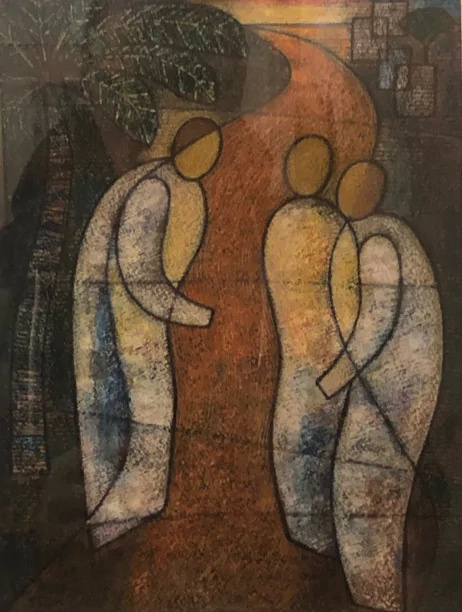
The Focolare Movement has asked me to comment on the ‘Word of Life’ for April for its German-speaking region — Germany, Austria and German-speaking Switzerland. It is taken from the account of the road to Emmaus (Luke 24:29).
It is a journey from Jerusalem to Emmaus I should have made myself this month, with a group, as part of JC2033… But the current war has made this project impossible. We have postponed it until next year, after Easter.
“Stay with us, for evening is falling.”
Two disciples leave Jerusalem, disheartened by Jesus’ death the previous day. They had hoped for so much, and now everything seems lost. On the road to the village of Emmaus, a stranger joins them. He listens to their sorrow and then explains the Scriptures to them: their hearts are warmed, though they do not yet know who he is. Upon reaching the village, the stranger pretends to continue on his way. But they urge him: “Stay with us, for it is nearly evening” (Luke 24:29). And the stranger agrees. During the meal, he takes bread and gives thanks in front of the disciples, before disappearing. Then their eyes are opened and they recognise that it is Jesus. Immediately they return to Jerusalem to announce the great news of the resurrection to the other disciples.
‘Stay with us, for evening is falling.’ These words seem simple, almost banal. Yet some Church Fathers recognize in them the cry of the soul that does not wish to sink into darkness: without Christ, night engulfs everything, but with him, even night becomes light. Others emphasise that Jesus pretends to walk away to awaken our desire to keep him with us: he waits for us to invite him. For Augustine, the words “stay with us” symbolise our prayer and our desire for the constant presence of Christ, not only during a meal, but throughout the Christian life.
“Stay with us, for evening is falling.”
This plea of the disciples is also our own. Even today, there is no shortage of nights. In our world, these take the form of wars, injustices and violence, but also of growing loneliness, spiritual emptiness and the suffering of a wounded creation. In our personal lives, these nights take the form of illness, bereavement, anxiety, discouragement and so many other forms of desolation.
There are also more inward nights: the ‘night of faith’ when God seems absent and prayer seems futile. And some even speak of a ‘night of the spirit’, a darkness where all consolation vanishes. A painful trial, yet a path of purification where God works deeply to unite us to himself.
It is this night that Jesus experienced when, on the cross, he cried out: “My God, my God, why have you forsaken me?” (Matthew 27:46). Chiara Lubich writes that he passed through all our nights: he is “the Light that became darkness and Love that became disunity[1]. ” From then on, our nights are filled with his presence and can become a place of encounter with him. Experienced alone, this darkness crushes us; shared in mutual love, it fades away, giving way to the joy promised by the Gospel.
“Stay with us, for evening is coming. ”
These words of the disciples do not belong solely to Luke’s account. They are given to us today as a prayer that can become our own. In our personal nights and in the nights of the world, we can say them with confidence.
A few years ago, I went through such a night, following a labour dispute. It lasted more than two years. This prayer, “stay with me”, often filled my mind. I also shared what I was going through with a Christian group. A strong unity was thus built up, with the spiritual presence of the Risen One among us. It gave me encouragement and light. Other paths then opened up before me.
Christ responds to those who invite him. He dwells through his enlightening Word, through the shared Bread in which he gives himself, through fraternal presence, sometimes in the guise of a stranger. The Risen One, who has traversed all the dark valleys, accompanies us through ours. Let us not delay in calling upon him, united in his name, and, like the disciples of Emmaus, let us go forth to proclaim this good news: “It is true! The Lord has risen.[2]”
Some suggestions for reflection and discussion:
• Where do I experience darkness, night, and disunity?
• Can I share these experiences with others? With whom?
• Where have I found comfort, help, light, or even experienced the resurrection?
Martin Hoegger, Lausanne
[1] Quoted by Giuseppe Maria Zanghí, La creazione. 3. La persona e le sue notti, in Nuova Umanità, XXXVI (2014/4-5), p. 352
[2] Luke 24:34
Laisser un commentaire